

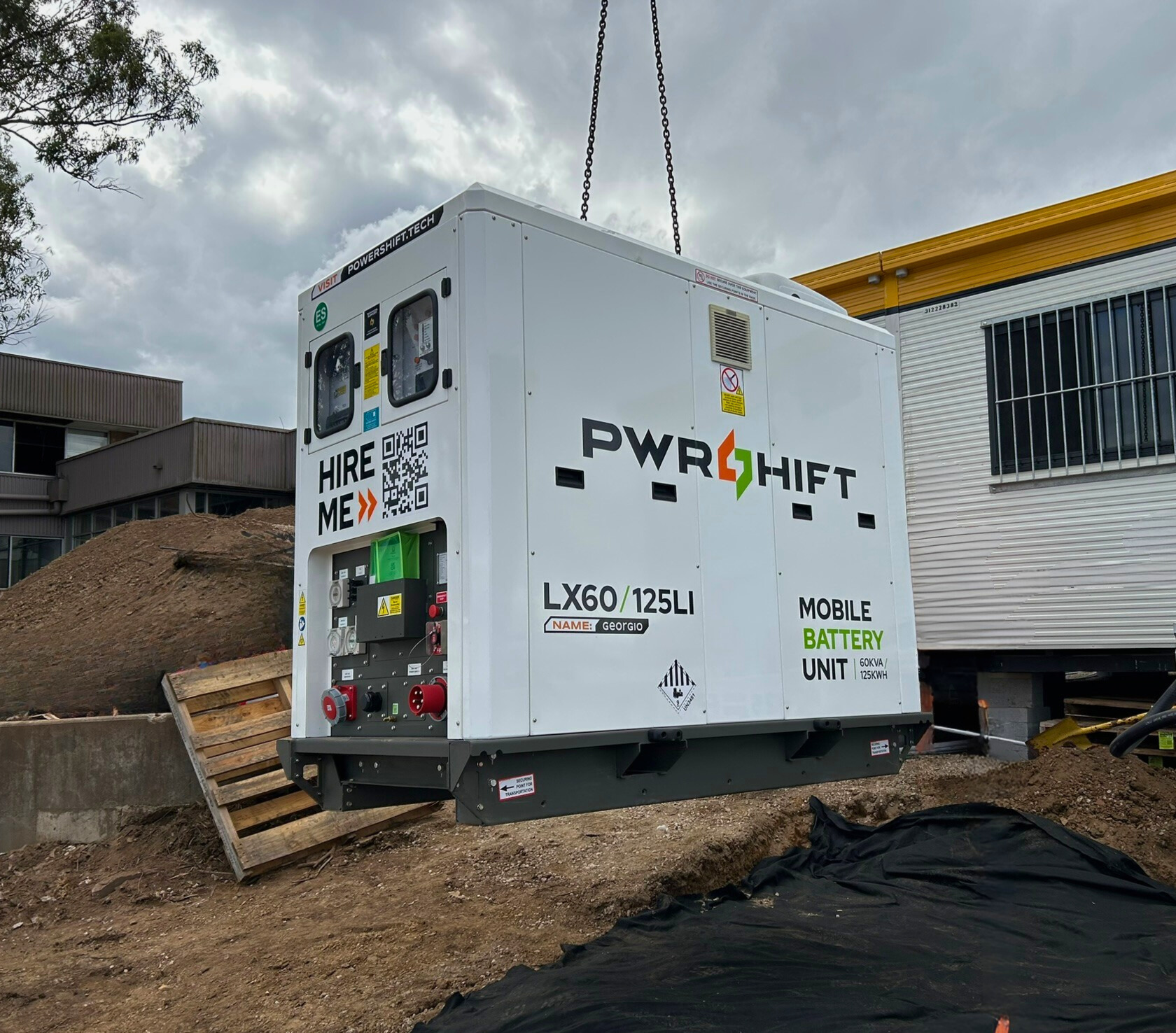
Mobile BESS (Battery Energy Storage Systems) are rapidly evolving as demand for cleaner temporary power solutions continues to grow, alongside an increasing adoption of renewables.
Innovations are continuing to emerge alongside market growth, opening up opportunities to displace traditional temporary power solutions like diesel generators in place of cleaner, quieter, smarter solutions.
So what do mobile battery systems have to offer?
There are a variety of benefits that make mobile BESS like the range that we offer, an attractive option. Some of these include:
- Reducing emissions – mobile BESS are a zero-emission technology in their own right. They are low emission when charging from the grid or solar, and can also pair with a generator, which still reduced emissions by up to 75%
- Cutting down costs – through eliminating the need for a generator or dramatically reducing run-time, you can cut down on associated fuel consumption and costs, and achieve major efficiency gains
- Quieter operation – unlike generators, mobile BESS are quiet when operating, which is beneficial to onsite crew, neighbouring businesses and communities, and also opens up potential for quiet overnight operations
- Mobility and flexibility – allow access to clean, quiet power, whenever and wherever its needed, with the ability to flexibly move that temporary power around daily, weekly, seasonally or on a project or site basis
- Efficiency gains through intelligent operations – acting as the centralised control system across a range of inputs and outputs, the battery can efficiently prioritise and manage power to allow for the most optimal solution
- Quick and easy access to power – be up-and-running within hours of arriving at a site – no assembly, disassembly or complex handling required
- Scalability – mobile BESS are modular and scalable, making them incredibly versatile and adaptable to different project needs
- Access to data and reporting – intelligent systems like those in our fleet offer rich data and reporting on key metrics like fuel and CO2 emissions saving, which can support ESG reporting
Let’s unpack and explore each of these areas further.
Reduce emissions
- Unlike diesel generators, mobile BESS units don’t emit any CO2 or other harmful pollutants like exhaust fumes, Nitrous Oxides (NOx) or Particulate Matter (PM) into the air while operating – they are a zero-emission technology
- They can charge from renewable sources like solar, for a 100% emission-free power solution
- They can also charge from the grid and from a diesel generator. While charging using diesel sounds counter-intuitive, in this set-up, diesel generator run-times, fuel and CO2 emissions can be reduced by up to 75%. Instead of running 24/7, the generator runs only for a short period at a maximum efficiency to charge up the battery and then automatically switches off.
To illustrate this in more detail, the table below shows average savings in running hours and diesel that can be achieved across a range of hybrid set-ups, using the POWRBANK MAX as an example, when paired with various generation sources:
SAVINGS IN GENERATOR RUN-TIMES, DIESEL AND CO2 EMMISSIONS ACROSS DIFFERENT POWRBANK MAX SET-UPS
| HYBRID SET-UP | AVERAGE SAVINGS IN GENSET RUN-TIMES | AVERAGE SAVINGS IN DIESEL AND CO2 |
|---|---|---|
| POWRBANK MAX + Generator | 70-75% | 40-50% |
| POWRBANK MAX + Grid connection | 100% | 75-100%* |
| POWRBANK MAX + Generator + Grid | 80-90% | 70-80% |
| POWRBANK MAX + Generator + Solar | 70-90% | 70-90% |
| POWRBANK MAX + Grid + Solar | 100% | 100% |
Opportunity for Cost Savings
- In a hybrid set-up where a mobile BESS is being paired with a diesel generator, there are significant opportunities to achieve cost savings. This is not only through dramatically cutting down fuel costs, but also through often being able to downsize the generator, as well as run it more efficiently – leading to less maintenance and more efficient, cost-effective use of the generator.
- There is often the opportunity to eliminate the need for a generator altogether, where renewables or a small grid connection are available, significantly reducing energy generation costs alongside reducing emissions, which in many cases can also be tracked and claimed as ACCUs (carbon credits).
- An often-overlooked benefit of implementing a mobile BESS solution is the natural increase in power resilience. As with any battery, the bigger the battery, the longer you can go between charges. A BESS with large storage capacity means that it can absorb periods of interruption to power – whether that’s because a generator is offline for maintenance, or the grid supply is unreliable or intermittent – and still continue to power the loads. This helps to significantly reduce the risk of productivity impacts that can be extremely costly to businesses.
QUIET operation
- Mobile BESS are quiet when operating, making them a fantastic option for any location where noise is an issue – a residential environment, overnight operations, events, filming, and even on work sites where constant noise pollution is detrimental to health, wellbeing, and safety.
- In contrast, traditional generators are noisy, which is not only negative to staff and/or operators, but often restricts the locations and timeframes they can operate within.
Mobility and Flexibility
- The ability to move mobile battery systems around is a game-changer, particularly for larger industrial-scale systems like our containerised units. It allows access to clean, quiet power, whenever and wherever its needed, with the ability to flexibly move that temporary power around daily, weekly, seasonally or on a project or site basis.
- Mobility opens up a range of applications including traditional temporary power settings like construction sites, through to off-grid or remote applications like mine sites or islands, emergency response, agricultural settings and more.
- Mobility also allows for innovative set-ups such as charging from one location and being able to use that power either at another place, or another time, or both – for example, charging silently from a small grid supply overnight, then driving the battery down the road to discharge into EV charging ports at an event during the day that don’t have their own permanent power supply.
Efficiency gains through intelligent operations
- A system is only as good as its brain. While not all systems are built equal, in general, mobile battery systems are more intelligent than generators and can act as the centralised control system across a range of inputs and outputs, as well as monitor and measure rich data including energy consumption and emissions savings.
- Our units have advanced control systems that can manage multiple inputs concurrently (e.g. solar, grid and generator), can discriminate and prioritise what inputs it uses based on parameters like how efficient and clean the source is (e.g. prioritising solar before a generator kicks in), and can respond to constantly fluctuating demands in load to provide exactly what is needed, when its needed.
- These factors combined allow for a highly efficient and optimised temporary power solution.
Quick and Easy Access to power
- Mobile BESS like those in our fleet can be up-and-running within hours of arriving at a site – there’s no assembly, disassembly or complex handling required.
- Powershift’s hire model enables quick and convenient delivery and fully supported deployment and operations – this can be critical when you have a need for power, fast. This could be due to not enough grid power to run your operations, with a 3-12 month wait for upgrades to your grid supply.
Scalability
- Mobile BESS are modular and scalable, making them incredibly versatile – you can connect them in “series” to increase storage capacity only, or in “parallel”, which increased both power and capacity.
- This capability enables power requirements to be tailored to specific needs, along with the ability to increase power and capacity as project or site requirements grow and change.
Access to Data and Reporting
- Mobile BESS with intelligent software like those in our fleet, allow for rich data and reporting on key metrics like fuel and CO2 emissions saving, which can support ESG reporting.
- Energy usage data also provides invaluable insights into a site or project’s energy consumption over time, enabling analysis of where efficiencies can be gained and proactive strategies can be implemented.